

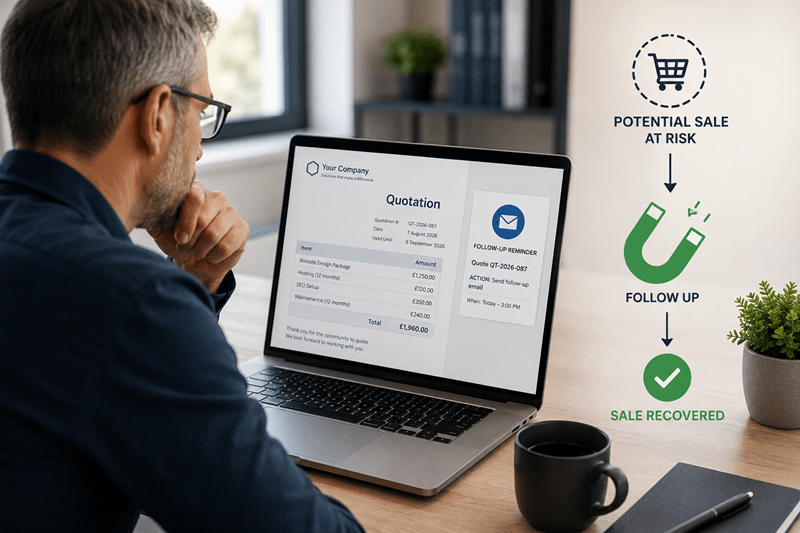
Sending quotations but not getting the sales? There could be a very simple reason. Learn how one small change to your quotation follow-up could uncover lost sales and turn more enquiries into customers.
You send a quotation to a potential customer.
They say they’ll have a look and get back to you.
A few days pass.
Then a week.
So you send an email:
“Hi, I just wanted to check whether you’ve had a chance to look over our quotation.”
And then you wait.
Sometimes you get a reply.
Quite often, you don’t.
The potential customer disappears, the quotation gets forgotten and eventually you assume you’ve lost the sale.
But what if the problem isn’t that you’re not following up?
What if you’re simply asking the wrong question?
There is a surprisingly simple way to follow up a quotation that can uncover objections, misunderstandings and problems that might otherwise remain hidden.
Instead of asking:
“Have you decided?”
try asking:
“Is there anything in the quotation that isn’t clear?”
It sounds almost too simple.
But it changes the entire nature of the conversation.
Why Your Usual Quotation Follow-Up May Not Work
Think about what happens when you ask a prospective customer:
“Have you had a chance to consider our quotation?”
You’re effectively asking them to make a decision.
If they’re ready to buy, that’s fine.
But what if they’re not?
Perhaps they’re unsure about the price.
Perhaps they don’t understand exactly what’s included.
Perhaps they’re comparing your quotation with another supplier.
Perhaps they need to discuss it with a business partner.
Perhaps they aren’t sure whether your service is suitable for them.
Or perhaps they’re interested but have simply been busy.
Your question doesn’t uncover any of those things.
It simply asks:
“Have you decided?”
And if the answer is “not yet”, ignoring your email is an easy option.
That’s why so many quotation follow-ups produce silence.
Ask What’s Stopping Them
Now change the question.
Instead of:
“Have you decided whether you’d like to go ahead?”
try:
“Is there anything in the quotation that isn’t clear, or anything you’d like me to explain?”
This is a much easier question for the customer to answer.
You aren’t asking them to commit.
You’re offering to help.
And, importantly, you’re giving them permission to raise an objection.
They might say:
“We weren’t sure whether installation was included.”
Now you can answer the question.
Or:
“The price was a little higher than we’d expected.”
Now you know what the objection is.
Or:
“We’re interested, but we won’t be ready until next month.”
That’s useful information too.
You have moved from chasing a sale to having a conversation about the sale.
You’re Not Chasing Customers
Many small business owners dislike sales follow-up because they don’t want to appear pushy.
They worry that another email will annoy the customer.
That’s understandable.
But there is a big difference between chasing someone for an answer and helping someone make a decision.
Compare these two messages:
“Just checking whether you’ve made a decision yet?”
and:
“Is there anything you’d like me to clarify about the quotation?”
The first creates pressure.
The second offers assistance.
That’s an important distinction.
A good quotation follow-up shouldn’t feel like a sales tactic. It should feel like good customer service.
Try the Five-Minute Follow-Up System
You don’t need expensive CRM software or an elaborate automated sales funnel to do this.
Start with something much simpler.
Whenever you send a quotation, set yourself a reminder.
Two days later
Send a short message confirming that the customer has received the quotation.
For example:
“Hi [Name], I just wanted to make sure you’ve received the quotation I sent over. If there’s anything you’d like me to clarify, please let me know. I’m happy to talk through the options.”
This is deliberately low pressure.
You’re simply opening the door.
About one week later
If you haven’t heard anything, follow up again.
This time, focus specifically on questions or concerns.
“Hi [Name], I wanted to follow up on the quotation I sent last week. Is there anything in it that isn’t clear, or anything you’d like me to change or explain?”
Now you’ve created an opportunity for the customer to tell you what’s preventing them from proceeding.
Two weeks later
If there’s still no response, make your final follow-up easy to answer.
For example:
“Hi [Name], just one final follow-up regarding the quotation. If you’ve decided not to go ahead, that’s absolutely fine, but if there’s anything holding things up or anything you’d like to discuss, please let me know.”
There’s no pressure.
You’re simply asking for clarity.
And clarity is valuable.
Don’t Be Afraid of Objections
A common mistake in sales is treating objections as bad news.
They’re not.
An objection is often simply a question that hasn’t been answered.
Consider:
“That’s more expensive than we expected.”
That isn’t necessarily a rejection.
It could be an invitation to explain the value.
“We’re not sure exactly what’s included.”
That’s not a rejection either.
It’s an opportunity to clarify the quotation.
“We need to speak to our business partner.”
Again, that’s information.
The real problem isn’t an objection.
The real problem is an objection you never discover.
If a customer has a concern and never tells you about it, you have no opportunity to address it.
They simply disappear.
Your Lost Quotations Are Valuable Market Research
Here’s where this simple follow-up technique becomes even more useful.
Don’t just use customer responses to try to win the immediate sale.
Record what people tell you.
After you’ve sent 20, 30 or 50 quotations, look for patterns.
Are customers repeatedly asking the same questions?
Are they frequently confused about something?
Are they regularly surprised by your pricing?
Are people asking whether you provide additional services?
Are customers saying they need something you don’t currently offer?
You may discover that your quotations, website or sales process aren’t explaining something clearly enough.
For example, imagine that five customers ask:
“Does that price include ongoing support?”
That’s a signal.
You could add a prominent section to your quotation explaining exactly what support is included.
If customers repeatedly ask about timescales, put your expected timescale somewhere more prominent.
If people continually compare your price with cheaper competitors, perhaps your quotation needs to explain the difference in service and value.
Your quotation follow-up therefore becomes a form of continuous customer research.
The Questions Your Customers Ask Can Improve Your Website
This is particularly useful for small businesses.
Your website should answer the questions customers have before they need to ask them.
But how do you know which questions those are?
Your enquiries and quotations can tell you.
Every question a prospective customer asks is potentially another piece of content for your website.
For example:
Customer question:
“Do you provide installation?”
Potential website improvement:
Add installation information to your service page.
Customer question:
“How long does it take?”
Potential website improvement:
Add a clear timescale section.
Customer question:
“What’s included in the price?”
Potential website improvement:
Create a detailed pricing or package comparison.
Customer question:
“Do you provide support afterwards?”
Potential website improvement:
Add a support section or FAQ.
This is one of the easiest ways to improve a business website.
Stop guessing what your customers want to know. Look at what they’re already asking.
What About Customers Who Never Reply?
Some people simply won’t respond.
That’s normal.
They may have chosen another supplier.
Their project may have been cancelled.
Their budget may have changed.
They may have become distracted by other priorities.
Don’t take it personally.
However, you can make your final follow-up extremely easy to answer.
For example:
“Just so I can update my records, should I keep this quotation open, or have you decided not to proceed?”
You could even give them three simple options:
1. We’d like to go ahead.
2. We’re still considering it.
3. We’re not going ahead.
A customer who doesn’t want to write a detailed email can simply choose an option.
And getting a definite “no” is often more useful than having an unanswered quotation sitting in your inbox indefinitely.
Don’t Spend More Money Finding Customers Until You’ve Checked This
Here’s the bigger lesson.
When sales are disappointing, businesses often assume they need more enquiries.
So they spend more on:
- Google Ads
- Facebook advertising
- social media
- SEO
- email marketing
- networking
- lead generation
More enquiries can certainly help.
But before you spend more money finding potential customers, look at what happens to the enquiries you already receive.
How many quotations have you sent in the last three months?
How many became customers?
How many didn’t?
And, crucially:
Do you know why?
You might discover that your business doesn’t actually have a lead-generation problem.
You have a conversion problem.
And improving your conversion rate can be considerably cheaper than finding another hundred potential customers.
The Five-Minute Rule
The whole idea can be reduced to one simple rule:
Every quotation deserves a follow-up.
Don’t send a quotation and hope.
Set a reminder.
Follow up.
But don’t simply ask:
“Have you decided?”
Instead ask:
“Is there anything that isn’t clear?”
That one question can uncover:
- unanswered questions
- pricing concerns
- misunderstandings
- timing problems
- competing quotations
- missing information
- decision-making delays
- service concerns
And occasionally it will uncover something even better:
A customer who was ready to buy but simply hadn’t taken the next step.
The Bigger Opportunity for Your Business
There is a temptation to think that increasing sales always means finding more people.
It doesn’t.
Sometimes the easiest sales are already sitting in front of you.
They’re the people who have contacted your business.
They’ve asked about your service.
They’ve requested a quotation.
They’ve shown an interest.
They’re already part way through the buying process.
The question is what happens next.
A simple, well-timed follow-up could be enough to bring some of those potential customers back into the conversation.
And if they don’t buy, their reasons for not buying can still help you improve your business.
Your quotations can become clearer.
Your website can answer more questions.
Your services can become better aligned with customer needs.
Your sales process can become more effective.
All because you started asking a slightly better question.
So the next time you send a quotation, don’t simply put a reminder in your diary saying:
“Follow up quote.”
Put this instead:
“Ask what isn’t clear.”
It could take less than five minutes.
And it might just find a sale you thought you’d already lost.
FAQ’s – The answers are in the article
- When should you follow up a quotation?
- How many times should you follow up a quote?
- What should you say when following up a quotation?
- How do you follow up a quotation without being pushy?
- What should you do when a customer doesn’t respond to a quote?
Want more customers from the enquiries you’re already getting?
Your website is often the first place a potential customer goes after receiving your quotation. If it doesn’t clearly explain what you do, answer common questions and give visitors confidence that you’re the right business to deal with, you may be losing potential customers before they ever contact you.
At Web Design Imagineers, we help small and owner-managed businesses create straightforward, mobile-friendly websites designed around what their customers actually need to know.
If your website could be doing more of the selling for you, it may be time to take another look at it.
Visit the website: https://webdesign-imagineers.co.uk
============================================
Written & Compiled by Graham J. McLusky, founder of Web Design Imagineers.
Graham has over 25 years’ experience helping UK businesses build websites that generate enquiries and long-term visibility. Visit Author page: https://webdesign-imagineers.co.uk/author-entity-graham-mclusky-webdesign-imagineers